Immaterials: Light painting WiFi
The city is filled with an invisible landscape of networks that is becoming an interwoven part of daily life. WiFi networks and increasingly sophisticated mobile phones are starting to influence how urban environments are experienced and understood. We want to explore and reveal what the immaterial terrain of WiFi looks like and how it relates to the city.
This film is about investigating and contextualising WiFi networks through visualisation. It is made by Timo Arnall, Jørn Knutsen, Einar Sneve Martinussen. The film is a continuation of our explorations of intangible phenomena that have implications for design and effect how both products and cities are experienced. Matt Jones of BERG has summarised these phenomena as ‘Immaterials’, and uses sociality, data, time and radio as examples. Radio and wireless communication are a fundamental part of the construction of networked cities. This generates what William Mitchell called an ‘electromagnetic terrain’ that is both intricate and invisible, and only hinted at by the presence of antennas (2004, p.55).
Investigating WiFi
In order to study the spatial and material qualities of wireless networks, we built a WiFi measuring rod that visualises WiFi signal strength as a bar of lights. When moved through space the rod displays changes in the WiFi signal. Long-exposure photographs of the moving rod reveal cross sections of a network’s signal strength.

WiFi outside the Oslo School of Architecture and Design
The measuring rod is inspired by the poles land surveyors use to map and describe the physical landscape. Similarly, our equipment allows us to reveal and represent topographies of wireless networks. The measuring rod uses a typical mobile WiFi antenna to measure reception, and draw out 4 metre tall graphs of light.

Walking with the WiFi measuring rod.
The size of the measuring rod and the light paintings it creates emphasises the architectural scale at which WiFi operates, and situates the networks in the physical environments that they are a part of. The light of the measuring rod pulses as it is being moved, which creates dashed lines rather than solid ones. This creates a semi-transparent texture that allows the visualisation to appear within the physical setting without covering it.

The dashed lines makes it possible to see through the graphs..
Material qualities of WiFi
December in Oslo is dark, making it an ideal month for light painting. During a few weeks of walking, measuring and photographing we visualised a number of networks in the Grünerløkka area in Oslo. The visualisations illustrate how WiFi networks in this neighbourhood are ubiquitous, but also fragmented and qualitatively different. The strength, consistency and reach of the network says something about the built environment where it is set up, as well as reflecting the size and status of the host. Small, domestic networks in old apartment buildings flow into the streets in different ways than the networks of large institutions. Dense residential areas have more, but shorter range networks than parks and campuses.

A WiFi network from an 1890s apartment building spilling into the street.

A dense network in the forecourt of the Oslo School of Architecture and Design (AHO).
Our expeditions around Grünerløkka, and the time-consuming work of measuring networks by walking with a 4 metre tall instrument gave us a sense of the relationships between WiFi networks and the physical environment. Architectural forms, building materials and the urban landscape shape how networks spread into the city, and can make WiFi seem spatially unpredictable. The light paintings show how the network’s behaviour depends on where it is located and how the city around it is built.
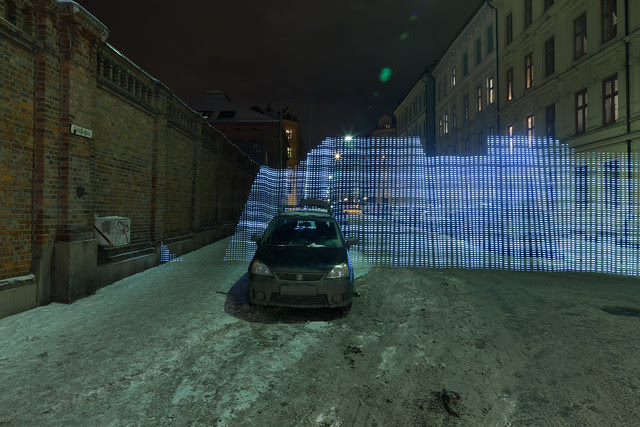
A brick wall creating a shadow in a network protruding from the other side.
WiFi networks can, both practically and metaphorically connect different environments. The radio waves from WiFi base stations flow from indoor domestic spaces and semi-private work places, into public parks, streets and bus stops. A typical example of how WiFi networks can bring new functions to urban environments is the case of a university network extending into a nearby park. This makes it possible for students to use the park as a networked area when the seasons allow it. However, this password protected park-network is both technically invisible and practically unavailable for anyone else.

A university WiFi network stretching across a park.

A bus stop within a WiFi network.
The light paintings show how WiFi networks are highly local, informal and fragmented, but also illustrate how these networks make up a highly evolved, yet largely inaccessible urban infrastructure that is mainly created by its users. The visualisations demonstrate how WiFi is a part of the urban landscape, and how networks are both shaped by the environment and influence how urban spaces can be used. This connects to Genevieve Bell and Paul Dourish’s 2004′s research and discussions on how networks, computing and urban environments can be understood as interwoven layers of the urban experience:
The spaces into which new technologies are deployed are not stable, not uniform, and not given. Technology can destabilise and transform these interactions, but will only ever be one part of the mix.
Bell & Dourish (2004, p.2)
Materialising the networked city
WiFi networks are an early example of the technological phenomena that makes up the networked city. As new communication standards and pricing models get introduced WiFi may become obsolete, but it is has been one of the first examples of effective ways of bringing the internet into the city. WiFi also have characteristics that illustrate challenges and possibilities posed by networked cities: WiFi is invisible, complex and increasingly mundane.

A WiFi network along a heavily trafficked road.
Adam Greenfield discusses how ‘the complex technologies the networked city relies upon to produce its effects remain distressingly opaque, even to those exposed to them on a daily basis’. Greenfield argues for unpacking the technologies and systems of the networked city ‘demystifying them, explaining their implications to the people whose neighborhoods and choices and very lives are increasingly conditioned by them’. The WiFi light-paintings can be situated within the discourses of the networked city as illustrations of how invisible, complex technologies may be contextualised and communicated through visualisation. This is taken up and discussed in a forthcoming book chapter about this work:
WiFi networks are both physically invisible and technically obscure, which makes them blackboxed on multiple levels. The detailed technical level of the infrastructures, data traffic and electromagnetic fields that our mobile devices are built upon are obviously complex and difficult to understand. However, there are also interactional and material aspects to how we experience these technologies that are similarly opaque and vaguely understood. This material level is especially important for design research as it is not only related to the technical and infrastructural properties of the technologies, but also to how they are experienced as spatial, material and interactive phenomena in the city.
Through visualisations and the process of creating them we have unpacked some of the qualities of WiFi networks and made them understandable as spatial and contextual phenomena. This process of making the phenomena material through visualisation shows how digital structures and physical environments are interwoven elements of the urban landscape. It also illustrates how our interactions with devices and networks are a part of the fabric of everyday urban life.
Martinussen (2011 forthcoming)
Conclusions
‘Immaterials: Light painting WiFi’ points towards potentials for materialising and contextualising invisible technologies through light painting and visualisations. Hopefully, the film situates the networked city within the everyday environments in which it take place. The light paintings illustrate how the networked city can be both ubiquitous, messy, informal and seamful, and emphasise how the invisible landscape of networks is another layer of the dense and complex urban contexts we already know.
Acknowedgements
‘Immaterials: light painting WiFi’ is created by Timo Arnall, Jørn Knutsen and Einar Sneve Martinussen. The film joins together Touch, YOUrban and Einar’s PhD project on design, technology and city life. Einar is also writes about this work in a chapter for a forthcoming book titled ‘Design Innovation for the Built Environment – Research by Design and the Renovation of Practice’ edited my Michael U. Michael U. Hensel.
Timo writes more about immaterials and WiFi on the Touch weblog.
Thanks to Andrew Morrison and Jack Schulze (BERG).
References
Bell, G. and Dourish, P. 2004. Getting Out of the City: Meaning and Structure in Everyday Encounters with Space. Workshop on Ubiquitous Computing on the Urban Frontier (Ubicomp 2004, Nottingham, UK.)
Greenfield, A. 2009. The kind of program a city is [online]. Available at: http://speedbird.wordpress.com/2009/10/08/the-kind-of-program-a-city-is-2/ [Accessed 24 February 2011].
Martinussen, E. 2011 forthcoming. Making material of the networked city. In: Design Innovation for the Built Environment – Research by Design and the Renovation of Practice. Routledge, Taylor & Francis.
Mitchell, W.J. 2004. Me++: The Cyborg Self and the Networked City. Cambridge MA: The MIT Press.

No comments